
Fig.2. Sensitivity distribution of clinical isolates of S. epidermidis (24 strains, 106 CFU/ml) Staphylococcus aureus Staphylococcus epider- midis Ent
|
|
|
- ゆりか かみこ
- 7 years ago
- Views:
Transcription
1
2 Fig.2. Sensitivity distribution of clinical isolates of S. epidermidis (24 strains, 106 CFU/ml) Staphylococcus aureus Staphylococcus epider- midis Enterococcus faecalis
3 Klebsiella pneumoniae, Morganella morganii, Serratia marcescens
4 Fig. 7. Sensitivity distribution of clinical isolates Fig. 8. Sensitivity distribution of clinical isolates
5
6
7
8
9
10
11
12
13
14
15
16
17 Table 4. Overall clinical efficacy of NY-198 by Dr's evaluation Table 5. Overall clinical efficacy of NY-198 in acute uncomplicated cystitis Table 6. Overall clinical efficacy of NY-198 in complicated UTI
18 Table 7. Overall clinical efficacy of NY-198 in complicated UTI 400mg/day treatment Table 8. Overall clinical efficacy of NY-198 in complicated UTI 600mg/day treatment Table 9. Overall clinical efficacy of NY-198 classified by the type of infection
19 Table 10. Overall clinical efficacy of NY-198 classified by the type of infection 400mg/day Table 11. Overall clinical efficacy of NY-198 classified by the type of infection 600mg/day Table 12. Bacteriological response to NY-198 in acute uncomplicated cystitis Table 13. Strains* appearing after NY-198 treatment in acute uncomplicated cystitis * Persisted: Regardless of bacterial couni * Regardless of bacterial count
20 Table 14. Relation between MIC and bacteriological response to NY-198 treatment in uncomplicated cystitis No. of strains eradicated/no. of strains isolated Table 15. Bacteriological response to NY-198 in complicated UTI Table 16. Strains* appearing after NY-198 treatment in complicated UTI * Regardless of bacterial count * Persisted: Regardless of bacterial count
21 Table 17. Relation between MIC and bacteriological response to NY-198 treatment in complicated UTI No. of strains eradicated/no. of strains isolated
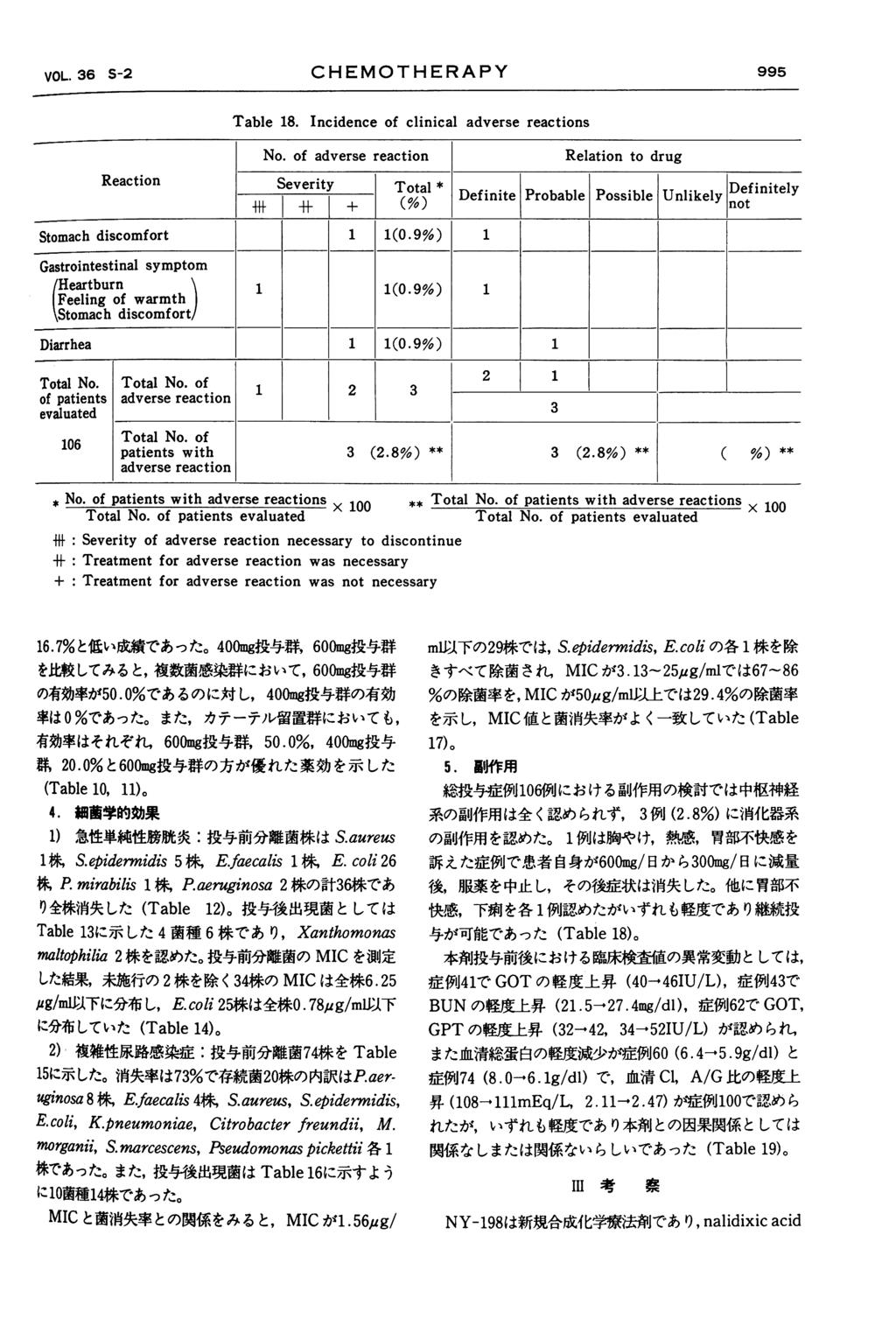
22 Table 18. Incidence of clinical adverse reactions No. of patients with adverse reactions / Total No. of patients evaluated of adverse reaction necessary to discontinue for adverse reaction was necessary for adverse reaction was not necessary Total No. of patients with adverse reactions / Total No. of patients evaluated
23 Table 19. Changes in laboratory test results
24
25 FUNDAMENTAL AND CLINICAL STUDIES ON NY-198 IN THE UROLOGICAL FIELD YOSHITSUGU NASU, MASAHIKO TSUGAWA, MIKI0 KISHI, AKIHIRO MIZUNO, HIROMI KUMON and HIROYUKI OHMORI Department of Urology (Director: Prof. H. OHmoRi), Medical School, Okayama University, Okayama ATSUSHI SONE, MANABU SUZUKI, MASAMICHI AMANO and HIROYOSHI TANAKA Department of Urology (Director: Prof. H. TANAKA), Kawasaki Medical University, Kurashiki MOTOYOSHI TAKADA Department of Urology, Kawasaki Hospital, Kawasaki Medical University, Okayama KATSUYOSHI KONDO and ATSUSHI KONDO Department of Urology, Okayama Red Cross Hospital, Okayama KATSUICHI NANBA Department of Urology, Okayama Municipal Hospital, Okayama Department Department Department TSUYOSHI SHIRAGA of Urology, Okayama Saiseikai Hospital, Okayama YASUHIRO KATAYAMA of Urology, Tamano City Hospital, Tamano TERUAKI AKAEDA of Urology, Tsuyama Central Hospital, Tsuyama HITOSHI TAKAMOTO Department of Urology, Kasaoka City Hospital, Kasaoka Department NOBUYUKI AKAZAWA of Urology, Onomichi City Hospital, Onomichi YOSHIKAZU HIRAI and YASUHIRO KANEMASA Department of Bacteriology (Director: Prof. Y. KANEMASA), Medical School, Okayama University, Okayama We studied NY-198, a new orally active antimicrobial agent, fundamentally and clinically in the urological field. 1) NY-198 showed broad and potent antibacterial activity. It inhibited Gram-positive bacteria including Enterococcus faecalis, and Gram-negative bacteria including Escherichia coli, Klebsiella pneumoniae, Proteus mirabilis, Proteus vulgaris, Serratia marcescens and Pseudomonas aeruginosa. 2) All of 33 patients with acute uncomplicated cystitis showed excellent or good response to NY-198 treatment. Thirty-eight of 59 patients with chronic complicated UTI also showed excellent or good response. 3) Side-effects were observed in three patients, who complained of gastro-intestinal disturbance. These symptoms disappeared soon after cessation of treatment of NY-198. Abnormal laboratory findings were noted in eight instances from six patients, but were mild and transient.
Key words : 7432-S, Oral cephem, Urinary tract infection Fig. 1. Chemical structure of 7432-S.
 Key words : 7432-S, Oral cephem, Urinary tract infection Fig. 1. Chemical structure of 7432-S. Table 1. Clinical summary of acute uncomplicated cystitis patients treated with 7432-S UTI : Criteria by the
Staphylococcus sp. K.pneumoniae P.mirabilis C.freundii E. cloacae Serratia sp. P. aeruginosa ml, Enterococcus avium >100ƒÊg/ml
 CHEMOTHERAPY SEPT. 1992 cefoperazone ceftazidime (CAZ), imipenem (IPM) Staphylococcus sp., Enterococcus (CPZ), faecalis, Escherichia coli, Klebsiella pneumoniae, Citrobacter freundii, Enterobacter cloacae,
Table 1. Antibacterial spectrum SBT ABPC ABPC CPZ : sulbactamiampicillin : ampicillin : cefoperazone
 Table 1. Antibacterial spectrum SBT ABPC ABPC CPZ : sulbactamiampicillin : ampicillin : cefoperazone (inoculum size= 106 CFU/ml) (Ĉ-lactamase producer : 2 strains) Fig. 1. Sensitivity distribution of
epidermidis, Enterococcus faecalis, Enterococcus Klebsiella pneumoniae, Proteus mirabilis, indolepositive Proteus spp., Enterobacter spp., Serratia
 epidermidis, Enterococcus faecalis, Enterococcus Klebsiella pneumoniae, Proteus mirabilis, indolepositive Proteus spp., Enterobacter spp., Serratia Table 3. Overall clinical efficacy of cefozopran in
VOL.35 S-2 CHEMOTHERAPY Table 1 Sex and age distribution Table 2 Applications of treatment with carumonam Table 3 Concentration of carumonam in human
 CHEMOTHERAPY Fig. 1 Chemical structure of carumonam Disodium(+)-(Z)-CCE1-(2-amino-4-thiazoly1)-2-[[(2S, -(carbamoyloxymethyl)-4-oxo-1-sulfonato-3-azetidinyll -2-oxoethylidene] amino] oxy] acetate 3S)-2
Fig. 1 Chemical structure of DL-8280
 Fig. 1 Chemical structure of DL-8280 Fig. 2 Susceptibility of cl in ical isolates to DL4280 Fig. 5 Susceptibility of clinical isolates to DL-8280 Fig. 3 Susceptibility of clinical isolates to DL-8280 Fig.
 Table 1. Influence of urine ph on MBCs of new quinolones against Escherichia coli NIHJ JC-2 and Pseudomonas aeruginosa 18S; MBCs in urine were compared with those in Miieller-Hinton broth. Table 2. Influence
Fig. 1 Chemical structure of KW-1070
 Fig. 1 Chemical structure of KW-1070 Fig. 2 Sensitivity distribution of clinical isolates Fig. 4 Sensitivity distribution of clinical isolates Fig. 3 Sensitivity distribution of clinical isolates Fig.
CHEMOTHERAPY
 CHEMOTHERAPY CHEMOTHERAPY Table 1 Antibacterial activity of BRL 28500 against standard strains of bacteria Fig, 1 Sensitivity distribution of ABPC-resistant E. coli isolated from urinary tract Fig. 2 Sensitivity
366 12 THE JAPANESE JOURNAL OF ANTIBIOTICS 65 6 Dec. 2012 1 8 DNA 2,3 16 12 20 171 2008 12 2010 11 2 3,558 4.44% 1.65% 1.17% 90% 9 Escherichia coli -
 Dec. 2012 THE JAPANESE JOURNAL OF ANTIBIOTICS 65 6 365 11 sita oxacin 1 1 1 1 1 1 2 2 3 3 1 1 1 2 3 2012 9 14 sita oxacin STFX 50 mg 10% 2008 1 2008 12 2010 11 2 STFX 1,452 91.4% 1,235/1,351 95.9% 466/486
CHEMOTHERAPY
 CHEMOTHERAPY CHEMOTHERAPY Table 1 Antibacterial activity of Sulbactam/CPZ against standard strains MIC mg/ml Inoculum size 106 CFU/ml * Sulbactam/CPZ= 1: 1 ** Concentration of Sulbactam+ CPZ CHEMOTHERAPY
VOL.42 S-1
 CHEMOTHERAPY APR. 1994 VOL.42 S-1 CHEMOTHERAPY APR. 1994 Table 1. Criteria for evaluation of clinical efficacy by the Japanese Society of Oral and Maxillo-Facial Surgeons Grades of symptoms and numerical
CHEMOTHERAPY JUN Citrobacter freundii 27, Enterobacter aerogenes 26, Enterobacter cloacae 27, Proteus rettgeri 7, Proteus inconstans 20, Proteus
 VOL. 32 S-4 CHEMOTHERAPY Fig. 1 Chemical structure of sodium cefoperazone Fig. 2 Chemical structure of sodium cefoperazone CHEMOTHERAPY JUN. 1984 Citrobacter freundii 27, Enterobacter aerogenes 26, Enterobacter
 Table 1.Concentration of gatifloxacin (Middle-ear) Table 2.Concentration of gatifloxacin (Paranasal sinuses) Table 3.Concentration of gatifloxacin (Tonsil) Table 4.No.of patients studied Table 5.Background
Table1MIC of BAY o 9867 against standard strains
 Table1MIC of BAY o 9867 against standard strains Fig.2Cumulative and Distribution Curves of MIC (S.aureus 54 strains) 106cfu/ml Fig.3Correlogram of MIC (S.aureus 54 strains) CHEMOTHERAPY 451 Fig.4Cumulative
日本化学療法学会雑誌第58巻第4号
 Escherichia coli Enterococcus faecalisstreptococcus agalactiae Klebsiella pneumoniae Staphylococcus epidermidis E. colie. faecalispseudomonas aeruginosa K. pneumoniae S. agalactiae E. coli E. coli μ p
CHEMOTHERAPY FEB Table 1. Activity of cefpirome and others against clinical isolates
 VOL.39 S-1 CHEMOTHERAPY FEB. 1981 Table 1. Activity of cefpirome and others against clinical isolates VOL.39 S-1 CHEMOTHERAPY FEB. 1991 72 M, 55.5 kg 66 F, 53 kg Chronic bronchitis Bronchopneumonia Peak
CHEMOTHERAPY JUNE 1993 Table 1. Background of patients in pharmacokinetic study
 CHEMOTHERAPY JUNE 1993 Table 1. Background of patients in pharmacokinetic study VOL. 41 S 1 Table 2. Levels (Đg/ml or Đg/g) of S-1006 in serum, bile, and tissue (gallbladder) after oral administration
 Table 1 Classification of female patients with vealcal irritating symptom by their signs Urination pain with other vesical irritability or not Table 2 Serum levels of DL-8280 after a single oral administration
 Key words : R-plasmid, Urinary tract infection, E. coli Fig. 1. MIC distribution against E. coli isolated from urinary tract (366 strains) and isolation - frequencies of drug-resistant strains Table 1.
Table 1. Antibacterial activitiy of grepafloxacin and other antibiotics against clinical isolates
 Table 1. Antibacterial activitiy of grepafloxacin and other antibiotics against clinical isolates Table 2-1. Summary of patients treated with grepafloxacin for respiratory infection 1) Out: outpatient,
CHEMOTHERAPY
 CHEMOTHERAPY VOL.41 S-2 Laboratory and clinical evaluation of teicoplanin CHEMOTHERAPY AUG. 1993 VOL.41 S-2 Laboratory and clinical evaluation of teicoplanin Table 1. Comparative in vitro activity of teicoplanin
988 CHEMOTHERAPY NOV. 1971
 988 CHEMOTHERAPY NOV. 1971 VOL. 19 NO. 8 CHEMOTHERAPY 989 Effect of medium-ph and inoculum size on activity of SB-PC heart infusion agar, mcg/ml Sensitivity distribution of Staphylococci to SB-PC in surgical
 Table 1. Antibacterial activity of cefdinir, cefixime, cefteram, cefuroxime, cefaclor and amoxicillin against standard strains Inoculum size: 108 cells/ml CFDN: cefdinir, CFIX: cefixime, CFTM: cefteram,
Fig. 1 Chemical structure of norfioxacin (AM-715)
 Fig. 1 Chemical structure of norfioxacin (AM-715) Table 1 Serum and biliary concentration of norfloxacin (AM-715) Table 2 Protocol for clinical evaluation of norfloxacin (AM-715) in the treatment of biliary
CHEMOTHERAPY Fig. 1 Chemical structure of CXM-AX
 Fig. 1 Chemical structure of CXM-AX NOV. 1986 Fig. 2 Sensitivity distribution of clinical isolates organisms (106 cells/ml) a Smurcus 27 strains d) P.m irabilis 15 strains b Ecol i 27 strains 111.morganii
 b) Gram-negative bacteria Fig. 2 Sensitivity distribution of clinical isolates : E. coli Fig. 3 Sensitivity distribution of clinical isolates : Pseudomonas Fig. 1 Sensitivity distribution of clinical isolates
 VOL. 17 NO. 7 CHEMOTHERAPY 1305 1) W. BRumFirr et al. : Clinical and laboratory studies with carbenicillin. Lancet 1: 1289~ 1293, 1967 2) E. T. KNUDSEN et al. : A new semisynthetic penicillin active against
CHEMOTHERAPY Table 1 Clinical effect of Sultamicillin
 CHEMOTHERAPY CHEMOTHERAPY Table 1 Clinical effect of Sultamicillin CHEMOTHERAPY Fig. 1 MICs of sultamicillin against respiratory pathogenic Branhamella catarrhalis 62 strains, inoculum size 106CFU/m1 Fig.
CHEMOTHERAPY JUNE 1987 Table1 Media used *BHIB, brain heart infusion broth (Difco); /3 -NAD, S -nicotinamidoadeninedinucleotide (Sigma Chemical Co.);
 VOL.35 S-2 CHEMOTHERAPY Fig.1 Chemical structure of carumonam CHEMOTHERAPY JUNE 1987 Table1 Media used *BHIB, brain heart infusion broth (Difco); /3 -NAD, S -nicotinamidoadeninedinucleotide (Sigma Chemical
Clostridium difficile ciprofloxacin, ofloxacin, norfloxacin Bifidobacterium Lactobacillus Lactobacillus Bacteroides fragilis B. fragilis C. difficile
 Clostridium difficile ciprofloxacin, ofloxacin, norfloxacin Bifidobacterium Lactobacillus Lactobacillus Bacteroides fragilis B. fragilis C. difficile Key words: temafloxacin, TA-167, Bacteroides fragilis,
日本化学療法学会雑誌第61巻第6号
 β Moraxella catarrhalis Escherichia coli Citrobacter Klebsiella pneumoniae Enterobacter cloacae Serratia marcescens Proteus Pseudomonas aeruginosa Acinetobacter Bacteroides fragilis β Haemophilus influenzae
VOL. 43 NO. 4
 VOL. 43 NO. 4 Fig. 1. Frequency of Enterococcus species from complicated UTI, 1988-1992. the number * of Enterococcus species/the number of cases with complicated UTI. Fig. 3 Epidemiologic characteristics
04-c-„FŒ{›xŒ¾-4.01
 544( 56 ) THE JAPANESE JOURNAL OF ANTIBIOTICS 58 6 Dec. 25 2003 2. * * Dec. THE JAPANESE JOURNAL OF ANTIBIOTICS 58 6 545( 57 ) 9 5 2003 8 2004 714 565 719 50 20 39 0 9 70 79 44.4 91.7% Escherichia coli
- 1 -
 - 1 - - 1 - ... 1... 2... 4... 5... 9... 11... 14... 16... 20... 21... 22... 23... 23 - 1 - - 2 - - 3 - - 4 - - 5 - - 6 - - 7 - - 8 - - 9 - ( ) - 10 - - 11 - Pseudomonas aeruginosa Escherichia coli Staphylococcus
 VOL.30 NO.10 CHEMOTHERAPY 1123 Fig,1 Group B case 6 hepatolithiasis,e.k.66 y.0.,f.45kg Postoperative wound infection Fig.2 Group B case 15 gastric cancer,k.k.60 y.o.,m. Postoperative peritonitis Fig.3
 Fig. 1 Chemical structure of norfloxacin Table 1. Institutes attended to the study The Department of Dermatology, Defense Medical College The Department of Dermatology, School of Medicine, Teikyo University
VOL. 34 S-2 CHEMOTH8RAPY 913
 VOL. 34 S-2 CHEMOTH8RAPY 913 914 CHEMOTHERAPY APR. 1986 Fig. 1 Chemical structure of T-2588 and T-2525 T- 2588 pivaloyloxymethyl (+ )- (6 R, 7 R)-7-[(Z)-2- (2-amino- 4-thiazolyl)-2-methox yiminoacetamido]-3-[(
 CHEMOTHERAPY Silver sulfadiazine (T 107) CHEMOTHERAPY Fig. 1 Item of patients Table 1 Criteria of bacteriological efficacy by the Committee xcellent: E Score of infection becomes to 0% at the end of medication.
CHEMOTHERAPY Proteus mirabilis GN-79 Escherichia coli No. 35 Proteus vulgaris GN-76 Pseudomonas aeruginosa No. 11 Escherichia coli ML-1410 RGN-823 Kle
 VOL. 29 NO.8 CHEMOTHERAPY 865 CHEMOTHERAPY Proteus mirabilis GN-79 Escherichia coli No. 35 Proteus vulgaris GN-76 Pseudomonas aeruginosa No. 11 Escherichia coli ML-1410 RGN-823 Klebsiella pneumoniae GN-69
 Table 1 Survival rates of infected mice given antibiotic doses producing peak serum a) S. aurcus Smith Challenge dose :7 ~10 (5% mucin) CFU/mouse. LD50: 1 ~103 (5% mucin) CFU/mouse. Table 2 Survival rates
Title 外傷性脊髄損傷患者の泌尿器科学的研究第 3 報 : 上部尿路のレ線学的研究並びに腎機能について Author(s) 伊藤, 順勉 Citation 泌尿器科紀要 (1965), 11(4): Issue Date URL
 Title 外傷性脊髄損傷患者の泌尿器科学的研究第 3 報 : 上部尿路のレ線学的研究並びに腎機能について Author(s) 伊藤, 順勉 Citation 泌尿器科紀要 (1965), 11(4): 278-291 Issue Date 1965-04 URL http://hdl.handle.net/2433/112732 Right Type Departmental Bulletin Paper
2108 CHEMOTHERAPY SEPT Table 1 Antimicrobial spectrum Fig. 1
 2108 CHEMOTHERAPY SEPT. 1977 Table 1 Antimicrobial spectrum Fig. 1 VOL. 25 NO. 7 CHEM 014 HERAPY 2109 Table 2 Susceptibility distribution of Staphylococcus aureus to aminoglycosides (54 strains) Table
CHEMOTHERAPY DEC Table 1 Antibacterial spectra of T-1982, CTT, CMZ, CTX, CPZ and CEZ 106 CFU/ml Note: P; Peptococcus, S; Streptococcus, G; Gaffk
 VOL. 30 S-3 CHEMOTHERAPY imeumoniae, Serratia marcescens, Proteus sp, CHEMOTHERAPY DEC. 1982 Table 1 Antibacterial spectra of T-1982, CTT, CMZ, CTX, CPZ and CEZ 106 CFU/ml Note: P; Peptococcus, S; Streptococcus,
Fig. 1 Clinical findings and extent of inflammation area in female urethrocystitis Fig. 2 Classification and distribution of female patients with blad
 Key words: Female with bladder irritability, Subjective symptoms, Pyuria, Bacteriuria Fig. 1 Clinical findings and extent of inflammation area in female urethrocystitis Fig. 2 Classification and distribution
CHEMOTHERAPY MAY. 1988
 CHEMOTHERAPY MAY. 1988 CHEMOTHERAPY Fig. 1 Chemical structure CHEMOTHERAPY MAY. 1988 VOL.36 5-1 CHEMOTHERAPY CHEMOTHERAPY MAY. 1988 VOL.36 S-1 CHEMOTHERAPY CHEMOTHERAPY MAY. 1988 VOL.36 S-1 CHEMOTHERAPY
CHEMOTHERAPY Table 1 Urinary excretion of mezlocillin Fig. 4 Urinary excretion of mezlocillin Fig. 3 Blood levels of mezlocillin
 CHEMOTHERAPY Fig. 2 Urinary excretion of mezlocillin Fig. 1 Blood levels of mezlocillin CHEMOTHERAPY Table 1 Urinary excretion of mezlocillin Fig. 4 Urinary excretion of mezlocillin Fig. 3 Blood levels
Hisao Takayasu Department of Urology, Faculty of Medicine, University of Tokyo Masaaki Ohkoshi Department of Urology, Tokai University School of Medic
 COMPARATIVE CLINICAL EFFECT OF AMIKACIN AND GENTAMICIN ON COMPLICATED URINARY TRACT INFECTIONS BY DOUBLE-BLIND METHOD Tsuneo Nishiura and Yukimichi Kawada Department of Urology, Gifu University School
 Osamu NEMOTO, M.D. Clinical and Bacteriological Research of Sucrose/ Povidone-Iodine Ointment (U-PASTA kowa) for Pressure Sores and Skin Ulcers Osamu Nemoto Department of Dermatology,Tonan Hosptal
 Table 1.Resistance criteria Fig.1.The resistance rates of piperacillin,ceftazidime, cefsulodin,imipenem,aztreonam,gentamicin,tobramycin,amikacin,isepamicin,fosfomycin and ofloxacin against 2,793 strains
400 46 THE JAPANESE JOURNAL OF ANTIBIOTICS 65 6 Dec. 2012 LVFX 100 mg 3 / 7 150 mg 2 / 7 2 2006 2008 9 LVFX PK PD 2009 7 100 mg 1 3 500 mg 1 1 AUC/MIC
 Dec. 2012 THE JAPANESE JOURNAL OF ANTIBIOTICS 65 6 399 45 2012 11 5 LVFX 500 mg 1 1 20 Chlamydia trachomatis C. trachomatismycoplasma genitalium M. genitalium LVFX 1 500 mg 1 1 7 22 22 C. trachomatis 17
 Table 1 Antibacterial spectra of CPM and other antimicrobials against anaerobes Fig. 1 In vitro activity of CPM and other antibiotics against B. fragilis (136 strains) Fig. 2 In vitro activity of CPM and
 1) Chemical name: Fig. 1 Chemical structure of TE-031 (-)-(3R,4S,5S,6R,7R,9R,11R,12R,13S,14R)-4-[(2, PYranosyl)oxy]-14-ethyl-12,13-dihydroxy-7-meth 6-dideoxy-3-C-methyl-3-O-methyl-a-L-ribo-hexo- oxy-3,5,7,9,11,13-hexamethy1-6-[[3,4,6-trideoxy-3-
 1.Streptococcus pneumoniae, Streptococcus pyogenes JC-1,S.aureus Smith,methicillin (DMPPC)- susceptible S. aureus subsp. aureus (MSSA) TR101, DMPPC-resistant S. aureus subsp. aureus (MRSA) TR102, Staphylococcus
CHEMOTHERAPY DEC phvlococcus aureus Staphylococcus Enterococcus faecalis Escherichia Klebsiella pneumoniae Serratia marcescens Pseudomonas cepac
 CHEMOTHERAPY DEC. 1988 phvlococcus aureus Staphylococcus Enterococcus faecalis Escherichia Klebsiella pneumoniae Serratia marcescens Pseudomonas cepacia 1 Bacteroides bivius Propionibacterium granulosum
 Table 1 Patients with various renal function * Ccr, Creatinine clearance ml/min per 1. 48 m2 ** C.V.D., Cerebral vascular disease ; C.R F., Chronic renal failure ; H.D., Hemoclialysis ; D., Dialyzer ;