
THE JAPANESE JOURNAL OF ANTIBIOTICS ( 37 ) methicillin-susceptible Staphylococcus aureus (MSSA) Escherichia coli levof
|
|
|
- ひろと うづき
- 9 years ago
- Views:
Transcription
1 242 ( 36 ) THE JAPANESE JOURNAL OF ANTIBIOTICS 63 _ 3 prulifloxacin * ** ** CMC * ** Prulifloxacin ulifloxacin (UFX)

2 THE JAPANESE JOURNAL OF ANTIBIOTICS ( 37 ) methicillin-susceptible Staphylococcus aureus (MSSA) Escherichia coli levofloxacin (MSSA, MIC 2 m g/ml; E. coli, MIC 4 m g/ml) 0% 11.8% % UFX UFX E. coli MIC 90 levofloxacin 1/2 1/4 Klebsiella pneumoniae UFX MIC m g/ml 0.03 m g/ml Pseudomonas aeruginosa UFX Streptococcus pneumoniae 3 UFX MIC 90 Salmonella Shigella UFX 0.12 m g/ml Prulifloxacin (PUFX) ulifloxacin (UFX) 1,2) 3,4) PUFX methicillin-resistant Staphylococcus aureus (MRSA) PUFX UFX 1. Ulifloxacin UFX ofloxacin (OFLX Sigma-Aldrich Co.) levofloxacin (LVFX Sequoia Research Products Ltd.) ciprofloxacin (CPFX Sequoia Research Products Ltd.) gatifloxacin (GFLX Sequoia Research Products Ltd.) tosufloxacin (TFLX Sequoia Research Products Ltd.) 1/ mol NaOH 9/10 UFX OFLX LVFX CPFX GFLX 640 mg /ml TFLX 160 mg /ml

3 244 ( 38 ) THE JAPANESE JOURNAL OF ANTIBIOTICS 63 _ 3 Table 1. * ** Table , (MIC) Methicillin-susceptible S. aureus (MSSA) methicillin-susceptible Staphylococcus epidermidis (MSSE) Enterococcus faecalis Escherichia coli Enterobacter cloacae Enterobacter aerogenes Klebsiella pneumoniae Citrobacter freundii Serratia marcescens Proteus vulgaris Proteus mirabilis Salmonella spp. Shigella spp. Pseudomonas aeruginosa Tripticase Soy Agar (Nippon Becton Dickinson Co., Ltd.) 35 C Streptococcus pyogenes Streptococcus pneumoniae Moraxella catarrhalis Sheep Blood Agar (T) (Nippon Becton Dickinson Co., Ltd.) Haemophilus influenzae Chocolate II Agar (Nippon Becton Dickinson Co., Ltd.) 35 C 5 6% CO 2 18 Peptostreptococcus spp. GAM 35 C Mc- Farland 0.5 Difco TM Mueller- Hinton broth (MHB Becton, Dickinson and Company) 10 8 CFU/mL MHB CFU/ ml MSSA MSSE E. faecalis E. coli E. cloacae E. aerogenes K. pneumoniae C. freundii S. marcescens Shigella spp. Salmonella spp. P. aeruginosa Difco TM Mueller-Hinton agar (MHA Difco) P. vulgaris P. mirabilis MHB Bacto TM Agar (Becton, Dickinson and Company) 3% S. pyogenes S. pneumoniae M. catarrhalis 5% MHA H. influenzae 80 C MHA 5% Peptostreptococcus spp. GAM 2

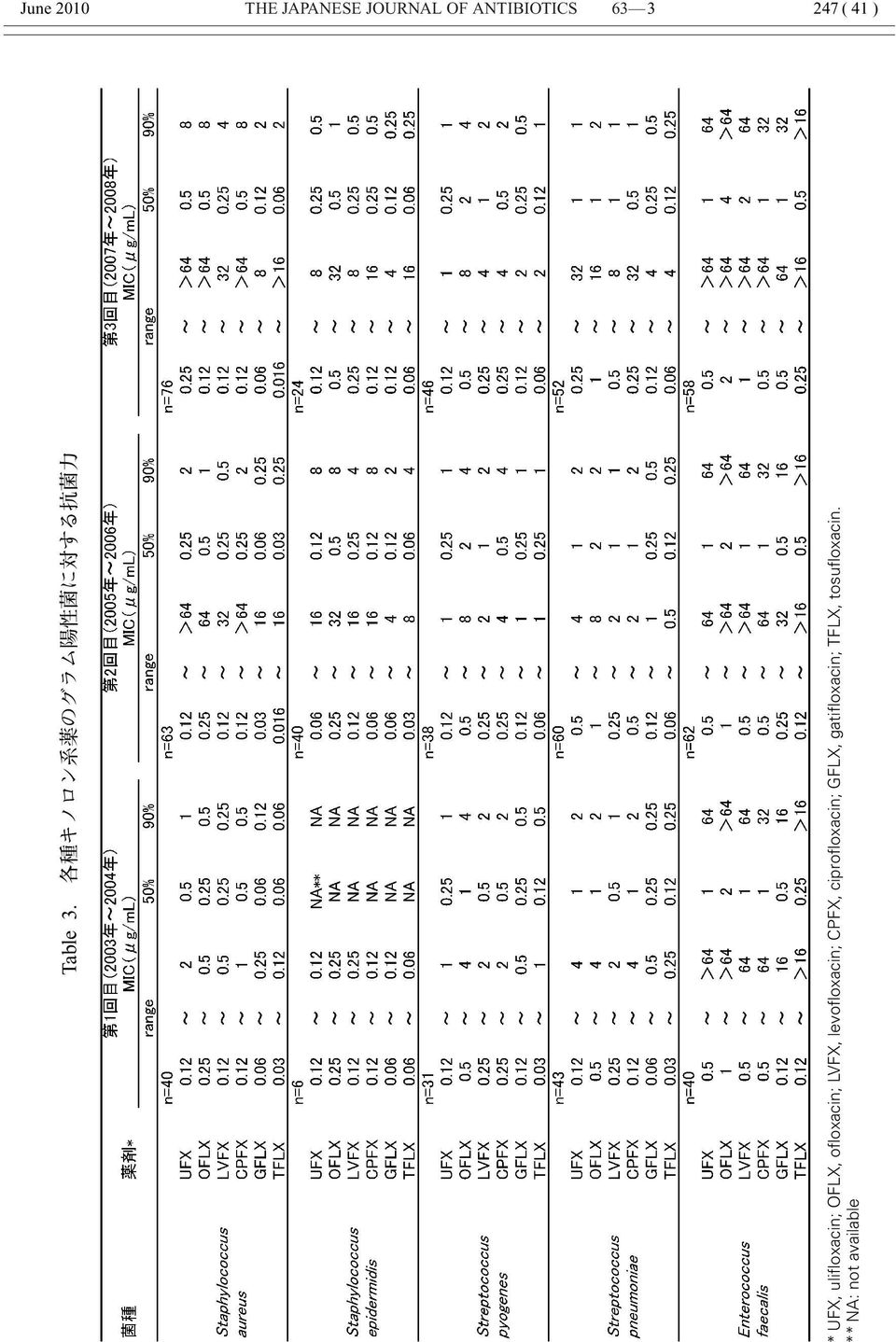
4 THE JAPANESE JOURNAL OF ANTIBIOTICS ( 39 ) UFX OFLX LVFX CPFX GFLX mg/ml 64 mg/ml TFLX mg/ ml 16 mg/ml 10 4 CFU/spot MSSA E. coli E. cloacae E. aerogenes K. pneumoniae C. freundii S. marcescens P. vulgaris P. mirabilis Shigella spp. Salmonella spp. P. aeruginosa 35 C 18 E. faecalis 35 C 20 MSSE 35 C 24 S. pyogenes S. pneumoniae H. influenzae M. catarrhalis 5 6% CO 2 35 C 18 Peptostreptococcus spp. 35 C 42 MIC 1. 2,202 (Table 2) MSSA S. pneumoniae E. aerogenes S. marcescens P. aeruginosa E. faecalis E. coli C. freundii P. vulgaris P. mirabilis S. pyogenes M. catarrhalis H. influenzae MSSE Salmonella spp. Shigella spp. Peptostreptococcus spp. E. cloacae K. pneumoniae MSSE MIC 50%MIC (MIC 50 ) 90%MIC (MIC 90 ) Table 3 4 (1) (Table 3) MSSA UFX MIC mg/ml MIC mg/ml 2 2 mg/ml 3 8 mg/ml UFX TFLX GFLX S. pyogenes E. faecalis UFX MIC 90 1 mg/ml 64 mg/ml S. pneumoniae UFX MIC 50 MIC mg/ml MIC (LVFX MIC: 8 mg/ml) 1 MSSE 2 UFX MIC 90 8 mg/ml MSSA mg/ml MSSA UFX LVFX CPFX OFLX (2) (Table 4) E. coli UFX MIC mg/ml 2 4 mg/ml 3 8 m g/ml P. mirabilis E. coli 3 MIC K. pneumoniae UFX MIC m g/ml m g/ml mg/ml P. aeruginosa 2

5 246 ( 40 ) THE JAPANESE JOURNAL OF ANTIBIOTICS 63 _ 3 *: methicillin-susceptible Table 2.

6 THE JAPANESE JOURNAL OF ANTIBIOTICS ( 41 ) Table 3. * UFX, ulifloxacin; OFLX, ofloxacin; LVFX, levofloxacin; CPFX, ciprofloxacin; GFLX, gatifloxacin; TFLX, tosufloxacin. ** NA: not available
7 248 ( 42 ) THE JAPANESE JOURNAL OF ANTIBIOTICS 63 _ 3 Table 4. * UFX, ulifloxacin; OFLX, ofloxacin; LVFX, levofloxacin; CPFX, ciprofloxacin; GFLX, gatifloxacin; TFLX, tosufloxacin.

8 THE JAPANESE JOURNAL OF ANTIBIOTICS ( 43 ) Table 4. * UFX, ulifloxacin; OFLX, ofloxacin; LVFX, levofloxacin; CPFX, ciprofloxacin; GFLX, gatifloxacin; TFLX, tosufloxacin.

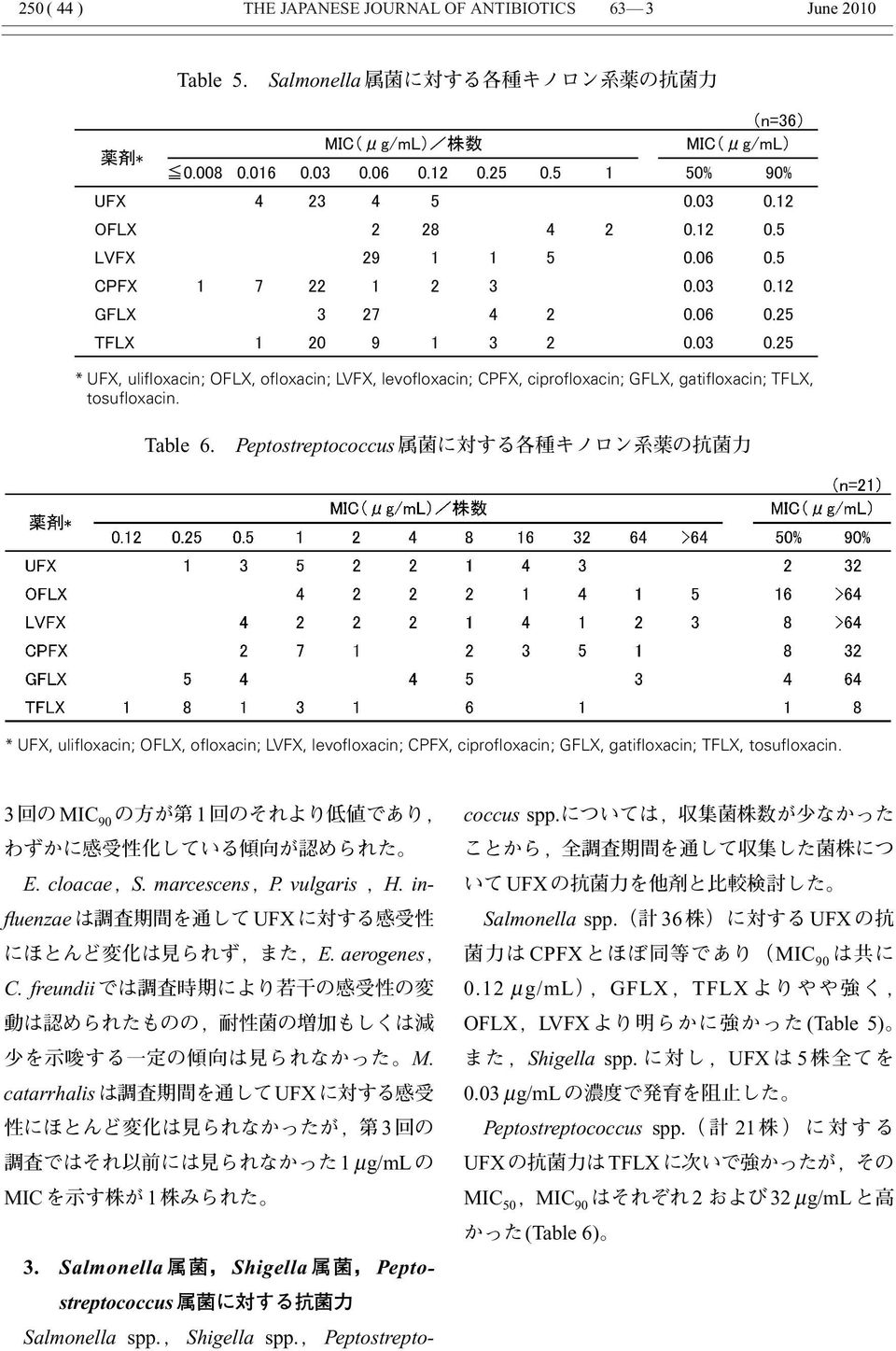
9 250 ( 44 ) THE JAPANESE JOURNAL OF ANTIBIOTICS 63 _ 3 Table 5. Salmonella * UFX, ulifloxacin; OFLX, ofloxacin; LVFX, levofloxacin; CPFX, ciprofloxacin; GFLX, gatifloxacin; TFLX, tosufloxacin. Table 6. Peptostreptococcus * UFX, ulifloxacin; OFLX, ofloxacin; LVFX, levofloxacin; CPFX, ciprofloxacin; GFLX, gatifloxacin; TFLX, tosufloxacin. 3 MIC 90 1 E. cloacae S. marcescens P. vulgaris H. influenzae UFX E. aerogenes C. freundii M. catarrhalis UFX 3 1 mg/ml MIC 1 3. Salmonella Shigella Peptostreptococcus Salmonella spp. Shigella spp. Peptostreptococcus spp. UFX Salmonella spp. 36 UFX CPFX MIC m g/ml GFLX TFLX OFLX LVFX (Table 5) Shigella spp. UFX mg/ml Peptostreptococcus spp. 21 UFX TFLX MIC 50 MIC mg/ml (Table 6)
10 THE JAPANESE JOURNAL OF ANTIBIOTICS ( 45 ) PUFX UFX UFX MSSA E. coli P. mirabilis UFX MIC 90 1 P. mirabilis MSSA E. coli LVFX CLSI MSSA (MIC 2 mg/ml) 0% 7.9% 11.8% E. coli (MIC 4 mg/ml) 14.6% 19.0% 20.8% ) ) ) MSSA LVFX 4.7% 5.5% 6.8% 3 LVFX MSSA E. coli 3 LVFX 1 MSSA Table 7. Levofloxacin E. coli E. coli 8,9) LVFX E. coli 15 (25.0%) (36.4%) (18.5%) (Table 7) E. coli E. coli 9) K. pneumoniae E. coli E. coli 10,11) P. aeruginosa LVFX (MIC 4 mg/ml)

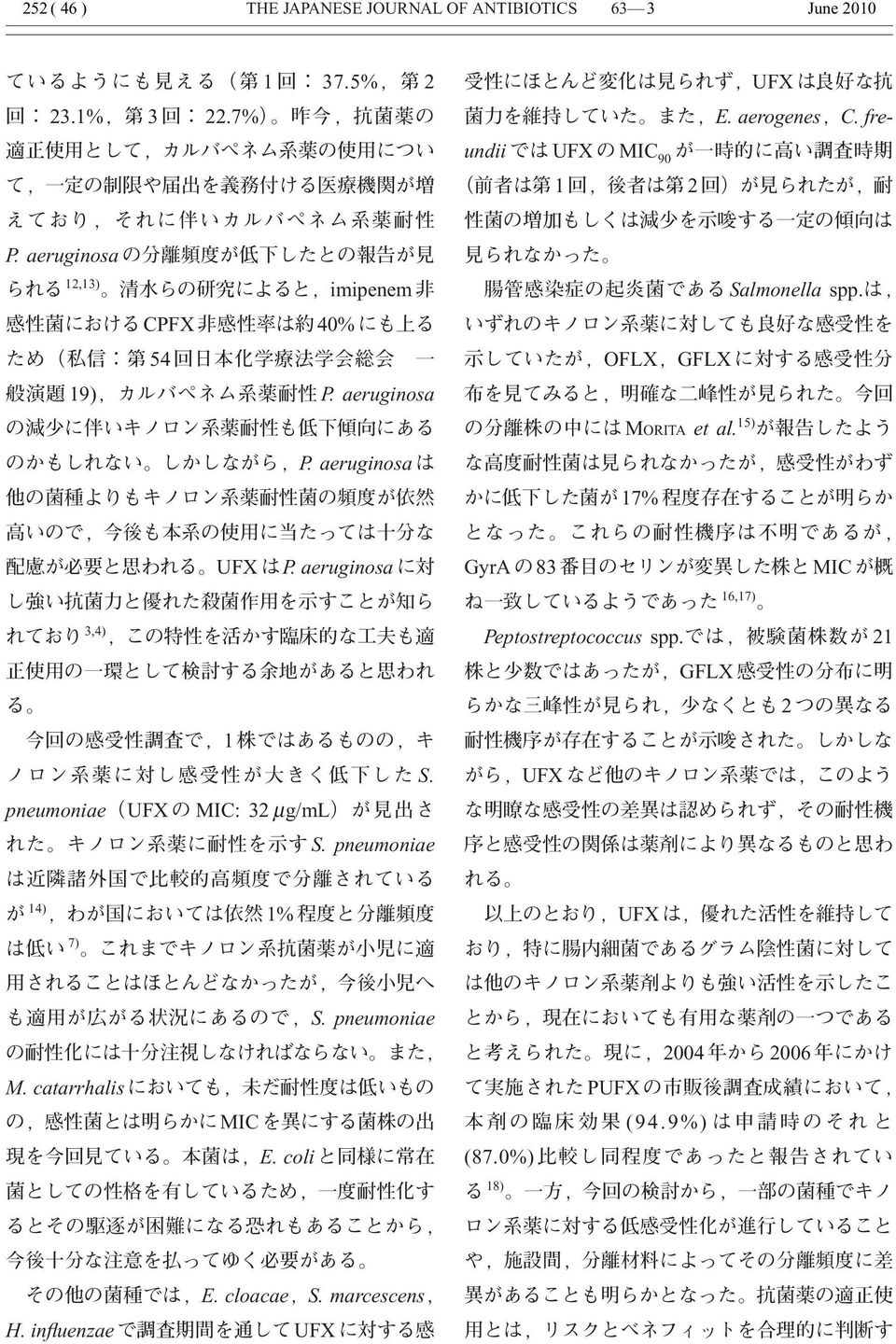
11 252 ( 46 ) THE JAPANESE JOURNAL OF ANTIBIOTICS 63 _ % % % P. aeruginosa 12,13) imipenem CPFX 40% 54 19) P. aeruginosa P. aeruginosa UFX P. aeruginosa 3,4) 1 S. pneumoniae UFX MIC: 32 mg/ml S. pneumoniae 14) 1% 7) S. pneumoniae M. catarrhalis MIC E. coli E. cloacae S. marcescens H. influenzae UFX UFX E. aerogenes C. freundii UFX MIC Salmonella spp. OFLX GFLX MORITA et al. 15) 17% GyrA 83 MIC 16,17) Peptostreptococcus spp. 21 GFLX 2 UFX UFX PUFX (94.9%) (87.0%) 18)
12 THE JAPANESE JOURNAL OF ANTIBIOTICS ( 47 ) 1) YOSHIDA, T. & S. MITSUHASHI : Antibacterial activity of NM394, the active form of prodrug NM441, a new quinolone. Antimicrob. Agents Chemother. 37: , ) NM441 in vitro in vivo 44(Sl): 26 41, ) prulifloxacin in vitro Jpn. J. Antibiotics 55: , ) Prulifloxacin NM394 Staphylococcus aureus, Escherichia coli Pseudomonas aeruginosa in vitro Jpn. J. Antibiotics 55: , ) ,475 Jpn. J. Antibiotics 58: 17 44, ) ,639 Jpn. J. Antibiotics 59: , ) ,571 Jpn. J. Antibiotics 62: , ) MURATANI, T. & T. MATSUMOTO: Bacterial resistance to antimicrobials in urinary isolates. Int. J. Antimicrob. Agents 24 (Suppl. 1): S28 31, ) BOYD, L. B.; R. L. ATMAR, G. L. RANDALL, et al.: Increased fluoroquinolone resistance with time in Escherichia coli from 17,000 patients at a large county hospital as a function of culture site, age, sex, and location. BMC Infect. Dis. 15; 8: 4, ) b- 54: , ) ROONEY, P. J.; M. C. O LEARY, A. C. LOUGHREY, et al. : Nursing homes as a reservoir of extended-spectrum b-lactamase (ESBL)-producing ciprofloxacin-resistant Escherichia coli. J. Antimicrob. Chemother. 64: , ) 21: , ) 22: , ) INOUE, M.; N. Y. LEE, S. W. HONG, et al.: PROTEKT : a multicentre study of the antibiotic susceptibility of respiratory tract pathogens in Hong Kong, Japan and South Korea. Int. J. Antimicrob. Agents 23: 44 51, ) MORITA, M.; K. HIROSE, N. TAKAI, et al. : Salmonella enterica serovar Typhi in Japan, : emergence of high-level fluoroquinolone-resistant strains. Epidemiol. Infect. 27: 1 4, ) CHAU, T. T.; J. I. CAMPBELL, C. M. GALINDO, et al.: Antimicrobial drug resistance of Salmonella enterica serovar typhi in asia and molecular mechanism of reduced susceptibility to the fluoroquinolones. Antimicrob. Agents Chemother. 51: , ) GRIGGS, D. J.; K. GENSBERG & L. J. PIDDOCK: Mutations in gyra gene of quinolone-resistant Salmonella serotypes isolated from humans and animals. Antimicrob. Agents Chemother. 40: , ) Prulifloxacin 53: , 2008

13 254 ( 48 ) THE JAPANESE JOURNAL OF ANTIBIOTICS 63 _ 3 Susceptibility surveillance of clinical isolates to fluoroquinolone antimicrobial agents from 2003 to 2008: Post-marketing study of prulifloxacin SHIN KAWAI Department of General Medicine, Kyorin University School of Medicine ATSUSHI YOSHIDA Division of Infection Control, Clinical Laboratory Medicine, Dokkyo Medical University Hospital MITSUHIRO OKAZAKI Clinical Laboratory Medicine, Kyorin University Hospital YOSHITO TSUJIHARA Clinical Laboratory, Kanagawa Prefectural Shiomidai Hospital KAZUHISA INUZUKA Department of Clinical Laboratory, Anjo Kosei Hospital KAZUHIDE TAKEUCHI Department of Clinical Laboratory, Osaka City University Hospital NAOKO YAMASHITA Department of Clinical Laboratory, Japan Seafarers Relief Association Kobe Ekisaikai Hospital MAKOTO ONODERA Clinical Support Department, Hiroshima University Hospital TORU HIRAISHI*, TAKASHI IDA**, KAZUNORI MAEBASHI** * Chemistry, Manufacturing & Control Research Laboratories, ** Pharmaceutical Research Center, Meiji Seika Kaisha, Ltd. Yearly changes in the susceptibility of clinical isolates to ulifloxacin (UFX) and other fluoroquinolones were examined through surveys over 3 periods. In the first survey, 534 strains derived from 19 species were collected from clinical specimens during 6 months from December 2003 to May In the same way, 805 strains were collected from December 2005 to May 2006 in the second survey, and 863 strains were from December 2007 to May 2008 in the third survey. Over these 3 study periods, the susceptibilities of fluoroquinolones against methicillin-susceptible Staphylococcus aureus and Escherichia coli were decreased. The isolation frequency of levofloxacinnonsusceptible strain was increased from 0% to 11.8% and from 14.6% to 20.8%, respectively. MIC 90 s of UFX against these pathogens were also increased, but its MIC 90 for E. coli was 2 to 4 times lower than that of levofloxacin. On the other hand, the susceptibility of strains of Klebsiella pneumoniae to UFX was increased. Among the fluoroquinolones tested, UFX showed the most potent activity against Pseudomonas aeruginosa, and no changes in the MIC 90 s occurred during the surveillance. Although one strain of Streptococcus pneumoniae isolated in the third study period showed levofloxacin-resistance (MIC, 8 mg/ml), there were nearly no changes in the MIC 90 s of any agents tested including UFX against S. pneumoniae during the surveillance. As for other bacterial species, a tendency to increase in resistance to UFX was not observed. The activity of UFX against Salmonella spp. and Shigella spp. was superior/equal to those of fluoroquinolones tested.

日本化学療法学会雑誌第61巻第6号
 β Moraxella catarrhalis Escherichia coli Citrobacter Klebsiella pneumoniae Enterobacter cloacae Serratia marcescens Proteus Pseudomonas aeruginosa Acinetobacter Bacteroides fragilis β Haemophilus influenzae
Table 1. Antibacterial activitiy of grepafloxacin and other antibiotics against clinical isolates
 Table 1. Antibacterial activitiy of grepafloxacin and other antibiotics against clinical isolates Table 2-1. Summary of patients treated with grepafloxacin for respiratory infection 1) Out: outpatient,
 1.Streptococcus pneumoniae, Streptococcus pyogenes JC-1,S.aureus Smith,methicillin (DMPPC)- susceptible S. aureus subsp. aureus (MSSA) TR101, DMPPC-resistant S. aureus subsp. aureus (MRSA) TR102, Staphylococcus
CHEMOTHERAPY
 CHEMOTHERAPY VOL.41 S-2 Laboratory and clinical evaluation of teicoplanin CHEMOTHERAPY AUG. 1993 VOL.41 S-2 Laboratory and clinical evaluation of teicoplanin Table 1. Comparative in vitro activity of teicoplanin
 Table 1.Quality control of MICs for reference strains Table 2.Antimicrobial activity of gatifloxacin against aerobic bacteria Table 4.Antimicrobial activity of gatifloxacin and other quinolones against
Fig. 1 Chemical structure of DL-8280
 Fig. 1 Chemical structure of DL-8280 Fig. 2 Susceptibility of cl in ical isolates to DL4280 Fig. 5 Susceptibility of clinical isolates to DL-8280 Fig. 3 Susceptibility of clinical isolates to DL-8280 Fig.
366 12 THE JAPANESE JOURNAL OF ANTIBIOTICS 65 6 Dec. 2012 1 8 DNA 2,3 16 12 20 171 2008 12 2010 11 2 3,558 4.44% 1.65% 1.17% 90% 9 Escherichia coli -
 Dec. 2012 THE JAPANESE JOURNAL OF ANTIBIOTICS 65 6 365 11 sita oxacin 1 1 1 1 1 1 2 2 3 3 1 1 1 2 3 2012 9 14 sita oxacin STFX 50 mg 10% 2008 1 2008 12 2010 11 2 STFX 1,452 91.4% 1,235/1,351 95.9% 466/486
epidermidis, Enterococcus faecalis, Enterococcus Klebsiella pneumoniae, Proteus mirabilis, indolepositive Proteus spp., Enterobacter spp., Serratia
 epidermidis, Enterococcus faecalis, Enterococcus Klebsiella pneumoniae, Proteus mirabilis, indolepositive Proteus spp., Enterobacter spp., Serratia Table 3. Overall clinical efficacy of cefozopran in
Staphylococcus sp. K.pneumoniae P.mirabilis C.freundii E. cloacae Serratia sp. P. aeruginosa ml, Enterococcus avium >100ƒÊg/ml
 CHEMOTHERAPY SEPT. 1992 cefoperazone ceftazidime (CAZ), imipenem (IPM) Staphylococcus sp., Enterococcus (CPZ), faecalis, Escherichia coli, Klebsiella pneumoniae, Citrobacter freundii, Enterobacter cloacae,
CHEMOTHERAPY JUN Citrobacter freundii 27, Enterobacter aerogenes 26, Enterobacter cloacae 27, Proteus rettgeri 7, Proteus inconstans 20, Proteus
 VOL. 32 S-4 CHEMOTHERAPY Fig. 1 Chemical structure of sodium cefoperazone Fig. 2 Chemical structure of sodium cefoperazone CHEMOTHERAPY JUN. 1984 Citrobacter freundii 27, Enterobacter aerogenes 26, Enterobacter
Fig.2. Sensitivity distribution of clinical isolates of S. epidermidis (24 strains, 106 CFU/ml) Staphylococcus aureus Staphylococcus epider- midis Ent
 Fig.2. Sensitivity distribution of clinical isolates of S. epidermidis (24 strains, 106 CFU/ml) Staphylococcus aureus Staphylococcus epider- midis Enterococcus faecalis Klebsiella pneumoniae, Morganella
 Table 1.Resistance criteria Fig.1.The resistance rates of piperacillin,ceftazidime, cefsulodin,imipenem,aztreonam,gentamicin,tobramycin,amikacin,isepamicin,fosfomycin and ofloxacin against 2,793 strains
Staphylococcus epidermidis Streptococcus pneumoniae Staphylococcus epidermidis Streptococcus pneumontae S. epidermidis Table 1. Summary of the organis
 Staphylococcus aureus S. aureus (MRSA) vancomycin (VCM), arbekacin (ABK) Streptococcus pneumoniae cefuzonam (CZON), cefpirome (CPR) S. pneumoniae Enterococcus faecalis ampicillin (ABPC), imipenem (IPM)
CHEMOTHERAPY JUNE 1987 Table1 Media used *BHIB, brain heart infusion broth (Difco); /3 -NAD, S -nicotinamidoadeninedinucleotide (Sigma Chemical Co.);
 VOL.35 S-2 CHEMOTHERAPY Fig.1 Chemical structure of carumonam CHEMOTHERAPY JUNE 1987 Table1 Media used *BHIB, brain heart infusion broth (Difco); /3 -NAD, S -nicotinamidoadeninedinucleotide (Sigma Chemical
CHEMOTHERAPY FEB Table 1. Activity of cefpirome and others against clinical isolates
 VOL.39 S-1 CHEMOTHERAPY FEB. 1981 Table 1. Activity of cefpirome and others against clinical isolates VOL.39 S-1 CHEMOTHERAPY FEB. 1991 72 M, 55.5 kg 66 F, 53 kg Chronic bronchitis Bronchopneumonia Peak
400 46 THE JAPANESE JOURNAL OF ANTIBIOTICS 65 6 Dec. 2012 LVFX 100 mg 3 / 7 150 mg 2 / 7 2 2006 2008 9 LVFX PK PD 2009 7 100 mg 1 3 500 mg 1 1 AUC/MIC
 Dec. 2012 THE JAPANESE JOURNAL OF ANTIBIOTICS 65 6 399 45 2012 11 5 LVFX 500 mg 1 1 20 Chlamydia trachomatis C. trachomatismycoplasma genitalium M. genitalium LVFX 1 500 mg 1 1 7 22 22 C. trachomatis 17
2 2 THE JAPANESE JOURNAL OF ANTIBIOTICS 69 1 Feb Neisseria gonorrhoeae ceftriaxone CTRX % 2010 CTRX 20 FQ staphylococci, E. faecium, N.
 Feb. 2016 THE JAPANESE JOURNAL OF ANTIBIOTICS 69 1 1 1 2013 69 11,762 2015 11 16 1994 2013 69 19 11,762 FQ 33 Streptococcus pyogenes, Streptococcus pneumoniae, Moraxella catarrhalis, Haemophilus influenzae
R06_01
 Staphylococcus aureus (MSSA) PCG (N=118,334) 57,369 (48.5%) 判定不能 :3 (0.0%) 60,962 (51.5%) CEZ (N=143,723) I:42 (0.0%) 143,635 (99.9%) R:46 (0.0%) CVA/AMPC (N=19,281) R:14 (0.1%) 19,265 (99.9%) 判定不能 :2
Clostridium difficile ciprofloxacin, ofloxacin, norfloxacin Bifidobacterium Lactobacillus Lactobacillus Bacteroides fragilis B. fragilis C. difficile
 Clostridium difficile ciprofloxacin, ofloxacin, norfloxacin Bifidobacterium Lactobacillus Lactobacillus Bacteroides fragilis B. fragilis C. difficile Key words: temafloxacin, TA-167, Bacteroides fragilis,
 Table 1. Antibacterial activity of cefdinir, cefixime, cefteram, cefuroxime, cefaclor and amoxicillin against standard strains Inoculum size: 108 cells/ml CFDN: cefdinir, CFIX: cefixime, CFTM: cefteram,
CHEMOTHERAPY Proteus mirabilis GN-79 Escherichia coli No. 35 Proteus vulgaris GN-76 Pseudomonas aeruginosa No. 11 Escherichia coli ML-1410 RGN-823 Kle
 VOL. 29 NO.8 CHEMOTHERAPY 865 CHEMOTHERAPY Proteus mirabilis GN-79 Escherichia coli No. 35 Proteus vulgaris GN-76 Pseudomonas aeruginosa No. 11 Escherichia coli ML-1410 RGN-823 Klebsiella pneumoniae GN-69
Table 1. Antibacterial spectrum SBT ABPC ABPC CPZ : sulbactamiampicillin : ampicillin : cefoperazone
 Table 1. Antibacterial spectrum SBT ABPC ABPC CPZ : sulbactamiampicillin : ampicillin : cefoperazone (inoculum size= 106 CFU/ml) (Ĉ-lactamase producer : 2 strains) Fig. 1. Sensitivity distribution of
04-c-„FŒ{›xŒ¾-4.01
 544( 56 ) THE JAPANESE JOURNAL OF ANTIBIOTICS 58 6 Dec. 25 2003 2. * * Dec. THE JAPANESE JOURNAL OF ANTIBIOTICS 58 6 545( 57 ) 9 5 2003 8 2004 714 565 719 50 20 39 0 9 70 79 44.4 91.7% Escherichia coli
CHEMOTHERAPY Table 1 Clinical effect of Sultamicillin
 CHEMOTHERAPY CHEMOTHERAPY Table 1 Clinical effect of Sultamicillin CHEMOTHERAPY Fig. 1 MICs of sultamicillin against respiratory pathogenic Branhamella catarrhalis 62 strains, inoculum size 106CFU/m1 Fig.
ヒビスコール液A カタログ
 1 2 3 2002 10 Centers for Disease Control and Prevention CDC A 1. 2. 0.2% 3. 1 A 2 3 4 5 6 7 1 1 1. 2. 3. 2 1. 1 0.2% 10 Pseudomonas aeruginosa ATCC 27853 20 20 Proteus vulgaris ATCC 13315 30 20 Escherichia
MIC MIC...
 50 mg 10% 2.7.36 2.7.36 2.7.36... 1 1.6... 1 2.6... 3 3.6... 5 3.16... 5 3.26... 12 3.36... 16 4.6... 17 5.6... 19 6.6... 20 2.7.3.3.16-1 MIC... 9 2.7.3.3.16-2 MIC... 10 2.7.3.3.16-3 MIC E. coli... 11
CHEMOTHERAPY DEC Table 1 Antibacterial spectra of T-1982, CTT, CMZ, CTX, CPZ and CEZ 106 CFU/ml Note: P; Peptococcus, S; Streptococcus, G; Gaffk
 VOL. 30 S-3 CHEMOTHERAPY imeumoniae, Serratia marcescens, Proteus sp, CHEMOTHERAPY DEC. 1982 Table 1 Antibacterial spectra of T-1982, CTT, CMZ, CTX, CPZ and CEZ 106 CFU/ml Note: P; Peptococcus, S; Streptococcus,
 Table 1 Antibacterial spectra of CPM and other antimicrobials against anaerobes Fig. 1 In vitro activity of CPM and other antibiotics against B. fragilis (136 strains) Fig. 2 In vitro activity of CPM and
 Key words : R-plasmid, Urinary tract infection, E. coli Fig. 1. MIC distribution against E. coli isolated from urinary tract (366 strains) and isolation - frequencies of drug-resistant strains Table 1.
988 CHEMOTHERAPY NOV. 1971
 988 CHEMOTHERAPY NOV. 1971 VOL. 19 NO. 8 CHEMOTHERAPY 989 Effect of medium-ph and inoculum size on activity of SB-PC heart infusion agar, mcg/ml Sensitivity distribution of Staphylococci to SB-PC in surgical
VOL. 43 NO. 4
 VOL. 43 NO. 4 Fig. 1. Frequency of Enterococcus species from complicated UTI, 1988-1992. the number * of Enterococcus species/the number of cases with complicated UTI. Fig. 3 Epidemiologic characteristics
日本化学療法学会雑誌第53巻第S-3号
 moxifloxacin in vitro moxifloxacin in vitro 17 9 6 17 11 21 moxifloxacinmflx in vitro cefdinir CFDNclavulanic acidamoxicillincvaampcclarithromycincamclindamycincldm levofloxacinlvfx 1MFLX Clostridium clostridiiformeclostridium
 Table 1.Concentration of gatifloxacin (Middle-ear) Table 2.Concentration of gatifloxacin (Paranasal sinuses) Table 3.Concentration of gatifloxacin (Tonsil) Table 4.No.of patients studied Table 5.Background
Shigella flexneri 2a, Shigella flexneri 3a, Shigella sonnei, Salmonella, Salmonella arizonae, Citorobacter freundii, Enterobacter aerogenes, Enterobac
 Key words: Edwardsiella tarda from Healthy Persons, H2S firoducinr. Escherichia coli Shigella flexneri 2a, Shigella flexneri 3a, Shigella sonnei, Salmonella, Salmonella arizonae, Citorobacter freundii,
 Table 1 Survival rates of infected mice given antibiotic doses producing peak serum a) S. aurcus Smith Challenge dose :7 ~10 (5% mucin) CFU/mouse. LD50: 1 ~103 (5% mucin) CFU/mouse. Table 2 Survival rates
CHEMOTHERAPY JUNE 1993 Table 1. Background of patients in pharmacokinetic study
 CHEMOTHERAPY JUNE 1993 Table 1. Background of patients in pharmacokinetic study VOL. 41 S 1 Table 2. Levels (Đg/ml or Đg/g) of S-1006 in serum, bile, and tissue (gallbladder) after oral administration
CHEMOTHERAPY
 CHEMOTHERAPY CHEMOTHERAPY Table 1 Antibacterial activity of Sulbactam/CPZ against standard strains MIC mg/ml Inoculum size 106 CFU/ml * Sulbactam/CPZ= 1: 1 ** Concentration of Sulbactam+ CPZ CHEMOTHERAPY
THE JAPANESE JOURNAL OF ANTIBIOTICS 68 3 June 2015 Streptococcus pneumoniae, Haemophilus influenzae, Moraxella catarrhalis % 2 S. pneumon
 June 2015 THE JAPANESE JOURNAL OF ANTIBIOTICS 68 3 189 49 1 : 14 1 2 2 3 1 2 3 2015 4 3 1 : 14 CVA/AMPC 1 : 14 27 CVA/AMPC 1 : 14 88.5% Streptococcus pneumoniae, Haemophilus influenzae, Moraxella catarrhalis
Table1MIC of BAY o 9867 against standard strains
 Table1MIC of BAY o 9867 against standard strains Fig.2Cumulative and Distribution Curves of MIC (S.aureus 54 strains) 106cfu/ml Fig.3Correlogram of MIC (S.aureus 54 strains) CHEMOTHERAPY 451 Fig.4Cumulative
日本化学療法学会雑誌第58巻第4号
 Escherichia coli Enterococcus faecalisstreptococcus agalactiae Klebsiella pneumoniae Staphylococcus epidermidis E. colie. faecalispseudomonas aeruginosa K. pneumoniae S. agalactiae E. coli E. coli μ p
THE JAPANESE JOURNAL OF ANTIBIOTICS 67 3 June 2014 STFX mg mg mg mg mg 1
 June 2014 THE JAPANESE JOURNAL OF ANTIBIOTICS 67 3 175 29 1 2 2 2 2 2 3 4 4 5 5 2 2 1 2 3 4 5 2014 4 15 STFX 50 mg 10% 2011 8 1 100 mg 1 1 2011 12 2013 5 226 1,186 1,089 1,069 2.11% 23/1,089 1.10% 12/1,089
 172( 38 ) THE JAPANESE JOURNAL OF ANTIBIOTICS 57 2 Apr. 2002 1 19 6 2002 5 8 4 254 254 (PBP) 90 83 65 142 PBP pbp1a, pbp2x, pbp2b 121 (49%), pbp1a, pbp2x 30 (12%), pbp2x, pbp2b 16 (6%), pbp2x 61 (24%),
VOL.35 S-2 CHEMOTHERAPY Table 1 Sex and age distribution Table 2 Applications of treatment with carumonam Table 3 Concentration of carumonam in human
 CHEMOTHERAPY Fig. 1 Chemical structure of carumonam Disodium(+)-(Z)-CCE1-(2-amino-4-thiazoly1)-2-[[(2S, -(carbamoyloxymethyl)-4-oxo-1-sulfonato-3-azetidinyll -2-oxoethylidene] amino] oxy] acetate 3S)-2
Fig. 1 Chemical structure of KW-1070
 Fig. 1 Chemical structure of KW-1070 Fig. 2 Sensitivity distribution of clinical isolates Fig. 4 Sensitivity distribution of clinical isolates Fig. 3 Sensitivity distribution of clinical isolates Fig.
- 1 -
 - 1 - - 1 - ... 1... 2... 4... 5... 9... 11... 14... 16... 20... 21... 22... 23... 23 - 1 - - 2 - - 3 - - 4 - - 5 - - 6 - - 7 - - 8 - - 9 - ( ) - 10 - - 11 - Pseudomonas aeruginosa Escherichia coli Staphylococcus
CHEMOTHERAPY Fig. 1 Chemical structure of CXM-AX
 Fig. 1 Chemical structure of CXM-AX NOV. 1986 Fig. 2 Sensitivity distribution of clinical isolates organisms (106 cells/ml) a Smurcus 27 strains d) P.m irabilis 15 strains b Ecol i 27 strains 111.morganii
 E Societe de Pathologie Infectieuse de Langue Francaise (, 1991) E Spanish Thoracic Society (1992) E American Thoracic Society (ATS : 1993. ü ù2001 ) E British Thoracic Society (1993, ü è2001 ) E Canadian
 b) Gram-negative bacteria Fig. 2 Sensitivity distribution of clinical isolates : E. coli Fig. 3 Sensitivity distribution of clinical isolates : Pseudomonas Fig. 1 Sensitivity distribution of clinical isolates
CHEMOTHERAPY Table 1 Urinary excretion of mezlocillin Fig. 4 Urinary excretion of mezlocillin Fig. 3 Blood levels of mezlocillin
 CHEMOTHERAPY Fig. 2 Urinary excretion of mezlocillin Fig. 1 Blood levels of mezlocillin CHEMOTHERAPY Table 1 Urinary excretion of mezlocillin Fig. 4 Urinary excretion of mezlocillin Fig. 3 Blood levels
R01
 1. 集計対象医療機関数 (1,792 医療機関 ) 13.2% (7 医療機関 ) 900 床以上 N=53 86.8% (46 医療機関 ) 19.2% (70 医療機関 ) 500 899 床 N=365 80.8% (295 医療機関 ) JANIS 参加 * 200 499 床 N=2,231 43.4% (968 医療機関 ) 56.6% (1,263 医療機関 ) JANIS 参加 200
CHEMOTHERAPY
 CHEMOTHERAPY CHEMOTHERAPY Table 1 Antibacterial activity of BRL 28500 against standard strains of bacteria Fig, 1 Sensitivity distribution of ABPC-resistant E. coli isolated from urinary tract Fig. 2 Sensitivity
 THE JAPANESE JOURNAL OF ANTIBIOTICS 57 1 33( 33 ) 2002 JA * 1 * 2 2003 12 15 * 1) * 2) 34( 34 ) THE JAPANESE JOURNAL OF ANTIBIOTICS 57 1 Feb. 1982 7 2002 (2002.4 2003.3) 1 174 131 (75.3%) 334 171 163 Staphylococcus
 Helicobacter pylori Helicobacter pylori Helkobacter pylori erythromycin (EM) Mueller Hinton broth (Difco) H. pylori Staphylococcus aureus ATCC 29213 Escherichia coli ATCC25922 amoxicillin (AMPC), clarithromycin
 70( 70 ) THE JAPANESE JOURNAL OF ANTIBIOTICS 57 1 Feb. Meropenem 2002 * * * * * * * * * * * * * * * * * * * * * * NTT Feb. THE JAPANESE JOURNAL OF ANTIBIOTICS 57 1 71( 71 ) * * * * 2003 12 22 Meropenem
Acecide_ProductsInformation2010PDF.indd
 53-0115-00-4PDF 53-0115-00-4PDF INDEX 1 3 9 11 12 16 21 38 39 40 42 43 44 45 46 47 53-0115-00-4PDF 3 1 Critical Semicritical Noncritical Disinfection Sterilization 53-0115-00-4PDF 2 53-0115-00-4PDF O =
 1) i) Barber, M. et al.: Brit. Med J, 2, 565, 19'49. ii) Barber, M.F.G. J. Hayhoe and J. E. M. Whithead: Lancet, 1120 `1125, 1949.-2) Bergey: Bergey's Manual of Determinative Bacteriology 7 th Ed: (1958).-3)
VOL.42 S-1
 CHEMOTHERAPY APR. 1994 VOL.42 S-1 CHEMOTHERAPY APR. 1994 Table 1. Criteria for evaluation of clinical efficacy by the Japanese Society of Oral and Maxillo-Facial Surgeons Grades of symptoms and numerical
 Fig. 1. Structures of NM394, NAD-358 and NAD-245 Fig. 2. Typical HPLC chromatograms of NM394 in human plasma by organic solvent extraction method (a): Blank plasma (b): Plasma spiked with NM394 and internal
日本化学療法学会雑誌第57巻第1号
 In vitro Streptococcus pneumoniae Escherichia coli in vitro Streptococcus pneumoniae Escherichia coli µs. pneumoniae E. coli µ Key words in vitrostreptococcus pneumoniae Escherichia coli Escherichia coli